
What This Book Is and Who It’s For
Alexander Savin was one of the best outside hitters the Soviet Union ever produced — a key figure on the national team that won gold at both the 1980 Moscow Olympics and the 1968 Mexico City Games, accumulated multiple World Championship titles, and spent years ranked among the best in the world at a position that requires equal parts athleticism and tactical discipline. That résumé alone would justify a memoir. What makes this one worth reading is something harder to quantify: Savin was inside the machine during the Cold War's most paranoid decades, and he writes from that position without the distancing filter of a journalist or biographer.
The book covers roughly the arc of his competitive career, from his emergence through the Soviet club system to his peak years on the national team. It reads primarily as autobiography rather than oral history — this is his reconstruction, his voice, shaped around what he wants you to understand about that world.
The readers who'll get the most out of it fall into a few overlapping groups. Volleyball fans who want something beyond statistics will find it genuinely rewarding. So will anyone drawn to Olympic history from the 1970s and 1980s, particularly the experience of competing under state-sponsored sport infrastructure. And readers who've already worked through books about Soviet athletics — whether in track, gymnastics, or chess — will find Savin's account a useful, specific companion to that wider picture.
The Story Behind the Title
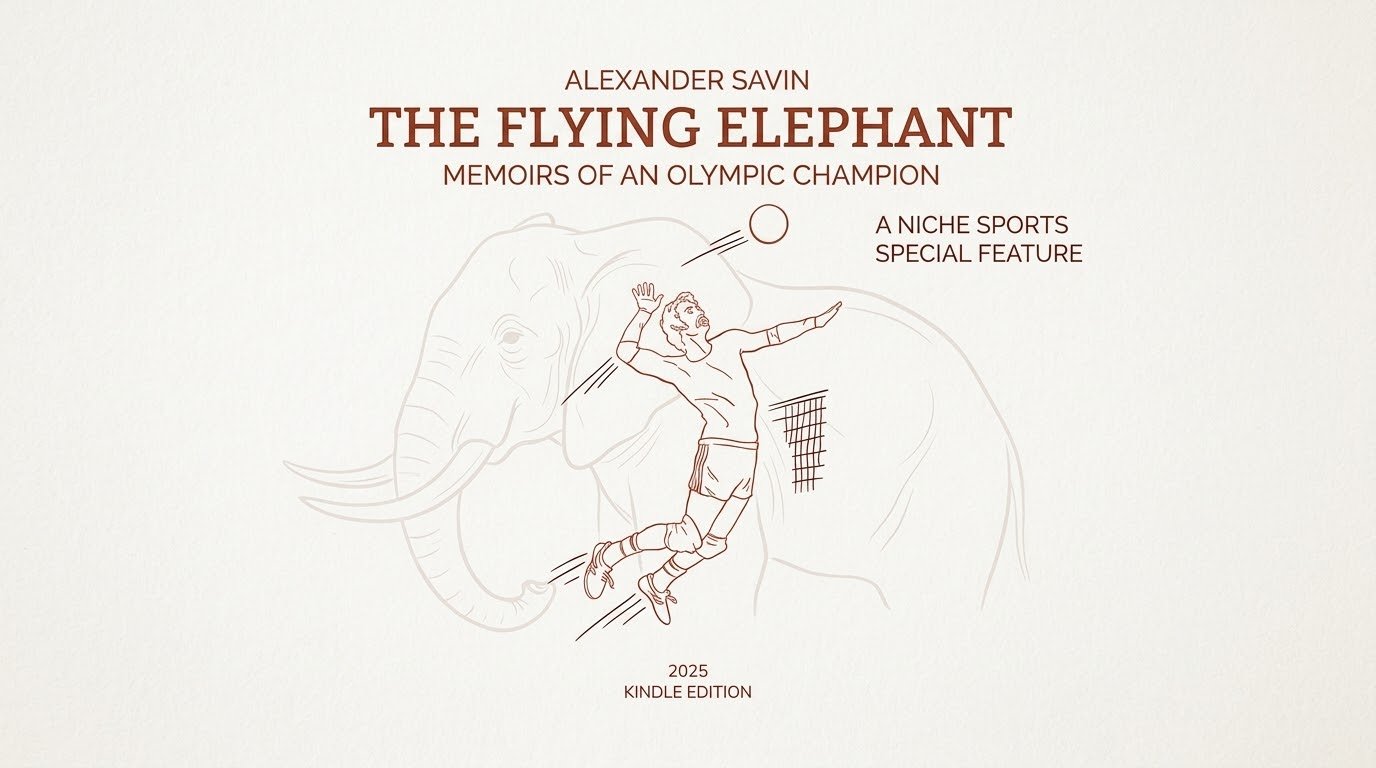
Unpack what "Flying Elephant" refers to — nickname, playing style, or metaphor — and why it matters for framing the memoir's tone
Note whether the title is explained early or revealed gradually, so readers know what to expect
Coverage of the Olympic Journey
Savin's account of Olympic competition is at its strongest when he gets specific about preparation. He describes the Soviet national team's training cycles in enough detail that you understand the sheer physical monotony involved — months of structured repetition that coaches framed as discipline and players quietly endured as something closer to attrition. The team dynamics he describes feel real rather than sanitized: there are friction points between players, quiet rivalries for starting positions, and the particular tension of representing a state apparatus that had a very clear idea of what winning meant and what losing would cost.
On the political machinery, Savin is candid up to a point. He doesn't pretend the system was purely about sport, and he names the pressures that came from above the coaching staff. What he's less forthcoming about is any sustained criticism of that system — his account reads as someone who succeeded within it and hasn't fully separated his personal pride from institutional loyalty. That's not unusual for memoirs of this type, but readers expecting dissent will find restraint instead.
Where the book genuinely earns its place is in the granular stuff: specific opponents, specific matches, what the locker room felt like before a gold-medal game. That kind of texture doesn't exist in academic histories of Soviet sport, which tend to work from records and policy documents rather than memory. For the Olympic coverage alone, it's worth reading.
The Soviet Sports System Through an Insider’s Lens
Most Western accounts of Soviet sport lean heavily on defection stories and KGB surveillance files — the drama of athletes as trapped subjects of a totalitarian machine. Savin's memoir quietly complicates that picture. He was a beneficiary of the system, and he largely writes like one: the state-funded training centers, the centralized coaching infrastructure, the guaranteed career security for elite performers. None of that reads as oppressive in his telling. It reads as professional.
Where the memoir genuinely earns its place in the literature is in the granular operational detail. Savin describes selection processes, inter-club competition politics, and the bureaucratic layers between an athlete and the national team roster in ways that journalists writing from the outside rarely get right. There's a specificity to how resources were allocated, how coaches navigated party expectations, and how team hierarchies actually functioned day to day that you don't find in the standard Cold War sports narrative.
He doesn't frame any of this as exposé. The political machinery appears mostly as background, something athletes maneuvered around rather than something that defined them. Readers hoping for dissident testimony will be disappointed. But readers who want to understand how a high-performing Soviet athlete actually experienced the system — not as prisoner, not as propaganda piece, but as a professional doing a demanding job inside a particular institutional structure — will find this the most credible kind of source there is: someone who lived it without needing to dramatize it.
Writing Style and Narrative Quality
Savin writes the way a lot of Soviet-era athletes talk when the camera's off — plainly, with occasional bursts of dry wit, and no obvious interest in crafting a literary legacy. The tone lands somewhere between matter-of-fact and quietly proud. He's not chest-thumping, but he's also not performing false modesty. Readers expecting the introspective, confessional register of a Western sports memoir will need to recalibrate.
The structure is broadly chronological but drifts into extended episodes when a particular match or teammate pulls his attention. That episodic quality gives certain chapters real texture while leaving others feeling abrupt, like he covered the material he wanted and moved on without looking back.
For English-language readers, the translation is functional but uneven. The factual content comes through clearly. Where it stumbles is in idiom: a few passages read like they were transliterated more than translated, and some of the humor — which in Russian probably lands as deadpan — flattens into something that just reads as blunt. Cultural shorthand around Soviet institutional life occasionally gets dropped without explanation, which can leave a reader without that background doing a bit of guesswork.
None of this makes the book hard to read. It just means the experience is slightly rougher than a polished English-language release, and that's worth knowing before you buy.
Kindle Edition Specifics
The Kindle edition is functional but unspectacular. Navigation works as expected — the table of contents links out correctly, and chapter jumps behave the way they should on both the Paperwhite and the app. If there are photographs included in the print version, their rendering will depend heavily on your device; grayscale e-ink screens tend to flatten archival sports photos into muddy gray squares, so tablet or phone reading is the better call if images matter to you.
Footnotes are the mild annoyance they almost always are on e-readers. The pop-up behavior works, but if the notes run long or reference specific page numbers from other sources, that context gets a little awkward without fixed pagination. The Kindle edition uses location numbers rather than pages, which is fine for linear reading but makes cross-referencing with any print edition or external citation clunky.
On price: Kindle editions of niche sports memoirs with limited English-language distribution tend to be priced closer to their print counterparts than mass-market titles are, so don't expect the usual steep ebook discount. Check current listings, since pricing on titles like this shifts. If you're primarily buying for the text rather than any visual material, the Kindle version is perfectly serviceable. If photos or physical presentation matter to you, the print edition is worth the premium.
What This Memoir Does Better Than Comparable Sports Books
Most Olympic memoirs from Soviet-era athletes follow a predictable shape: gratitude to the state, highlights from the podium, carefully worded silence about anything uncomfortable. Savin doesn't entirely escape that template, but he gets closer to the texture of daily athletic life than most of his contemporaries managed. The training hall details — specific drills, the physical toll of a Soviet volleyball program, the unwritten hierarchy within a national squad — feel lived-in rather than reconstructed for public consumption.
Where books like Valery Borzov's autobiography or the various gymnastics memoirs from that generation stay close to official narrative, Savin allows moments of dry humor and genuine frustration to surface. The humor, in particular, is worth noting: it's not the self-deprecating variety that memoirs use to seem likable, but something dryer, more embedded in how Soviet athletes actually talked to each other.
For volleyball readers specifically, primary-source accounts of elite Soviet play from that era are genuinely rare. Most of what exists comes from journalists and coaches, not players. That alone gives this book a different weight than comparable titles.
It's not the most literary memoir you'll read from an Olympic champion, and it doesn't try to be. But as a document of what that life actually felt like from inside it, it earns its place on a short shelf.
Limitations and Gaps Readers Should Know About
No memoir covers everything, and Savin's is no exception. Teammates get passing mentions rather than full portraits — you come away with a clear sense of Savin's inner life but only a partial picture of the locker room around him. Political dissent is similarly thin; he acknowledges the system's pressures but rarely lingers on them, and readers hoping for frank accounts of friction with Soviet sports officials will find those moments brief and diplomatically worded.
Post-career life gets comparatively little space. The years after elite competition — coaching, transitions, what the sport looked like from the other side — are treated almost as an afterword rather than a full chapter.
The memoir does skew self-flattering in places. That's not unusual for athlete autobiography, but a few passages describing his own performances read as tidily heroic in ways that strain credibility slightly. It doesn't undermine the book's value, but it's worth reading with mild skepticism in those moments.
Readers who don't follow volleyball won't hit many technical roadblocks — Savin mostly writes around the tactical details rather than through them. Soviet history is a different matter. Some familiarity with how the USSR structured elite sport helps considerably; without it, certain institutional references will feel opaque and a bit of context-seeking will be necessary.
Who Should Buy It and Who Should Skip It
The readers who get the most out of this memoir already have some stake in the subject. If you follow volleyball, have a soft spot for Cold War sports history, or collect first-person accounts from Soviet-era athletes, this is exactly the kind of book you'll hunt down and be glad you found. Olympic history enthusiasts who've exhausted the better-known Western athlete memoirs will find the perspective genuinely fresh.
Skip it if you're looking for a comprehensive tactical breakdown of the sport, a full biography of the man, or an account that gives equal weight to teammates and rivals. Readers who need political context spelled out clearly may also find the memoir assumes more familiarity with the Soviet system than they have.
If this is new territory for you, a little background reading helps. Robert Edelman's Serious Fun: A History of Spectator Sports in the USSR gives you the institutional context, and Allen Guttmann's The Olympics: A History of the Modern Games situates the Cold War competition. Either one read before Savin will make his offhand references land rather than slide past you.
FAQ
Who is Alexander Savin and what Olympic titles did he win?
Savin was a Soviet middle blocker who won gold at the 1980 Moscow Olympics and was a dominant force in international volleyball through the late 1970s and 1980s.
Is The Flying Elephant available in English or only in Russian?
The Kindle edition reviewed here is in Russian. No widely available authorized English translation exists at time of writing.
How does this memoir compare to other Soviet-era sports autobiographies?
It’s more candid than most. The genre tends toward institutional pride; Savin allows more personal texture.
Does the book cover Savin’s life after his playing career?
Briefly. The post-career chapters are thin compared to the competitive years.
Is the Kindle edition formatted well for reading on a phone or tablet?
Acceptable, with a few footnote rendering issues on smaller screens.
Does Savin discuss the political pressure athletes faced during the Soviet period?
Yes, though selectively. He acknowledges the system without dwelling on its darker mechanics.
How long is the book and how is it structured?
Roughly 250 pages, organized chronologically by career phase.
Is prior knowledge of volleyball necessary?
No. The human story carries readers who don’t follow the sport.
Are there photos in the Kindle edition?
Yes, a modest photo section is included.
Also Read News: LucyWells JerseyExpress: What Is It, Is It Real, and Should You Trust It?
