
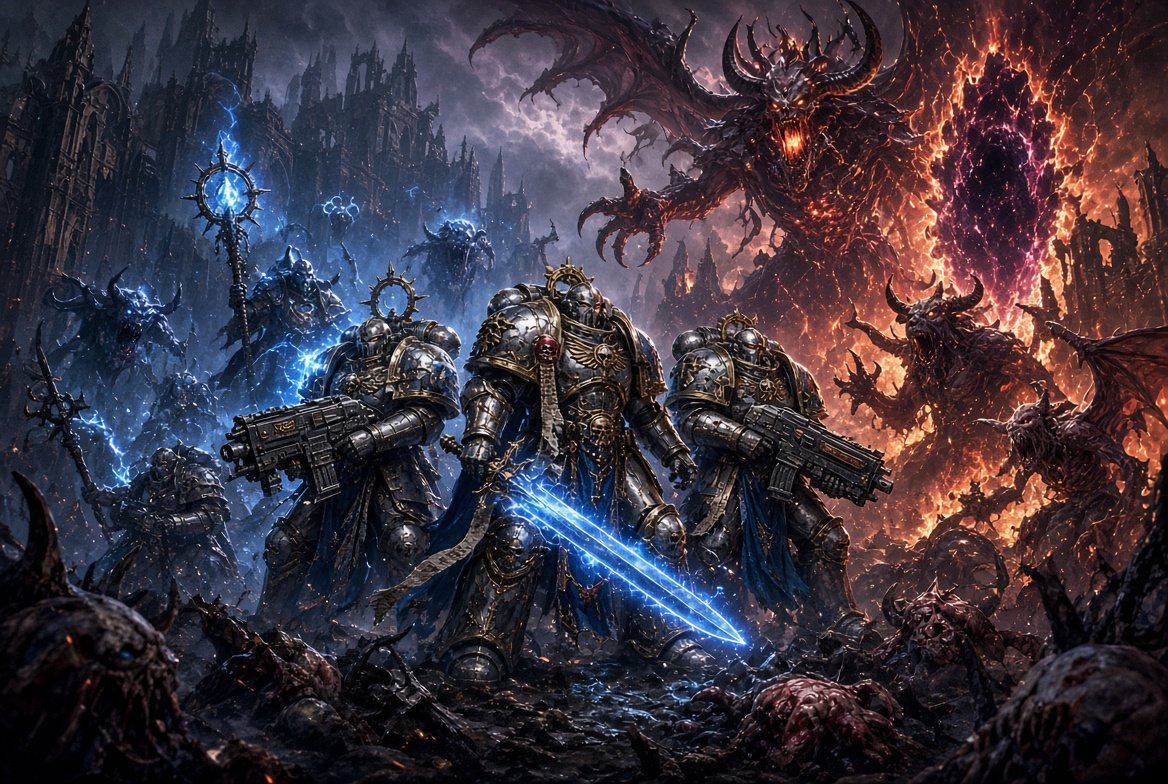
What LotsOfPower Actually Is
"LotsOfPower" doesn't appear to be an official DLC, named game mode, or credited community mod for Warhammer 40,000: Chaos Gate – Daemonhunters — at least not under that exact label. It's likely a colloquial nickname, a fan-coined shorthand, or a relatively obscure mod that hasn't broken into mainstream coverage. The game itself was developed by Complex Games and published by Frontier Foundry in 2022, and its documented DLC lineup consists of Duty Eternal and Execution Force, neither of which carries this name.
That said, the term almost certainly refers to gameplay centered on the game's Power resource system — specifically, builds and strategies that maximize Power generation and spending to chain high-impact Grey Knights abilities in rapid succession. Whether "LotsOfPower" is a specific mod you've downloaded, a community challenge run, or just what some players call a power-stacking build, the mechanics underneath it are firmly rooted in the base game's systems.
If you're working from a mod, the best place to confirm its exact scope is the mod page itself (likely on Nexus Mods or the Steam Workshop), since mod features vary by version and update. This guide covers the core Power mechanics in Chaos Gate – Daemonhunters and how to build around them effectively — which applies whether you're running a mod that amplifies those systems or just pushing the base game's power economy as hard as it'll go.
Core Power Mechanics and How They Work
Warhammer 40,000: Chaos Gate – Daemonhunters runs on a Willpower economy. Each Grey Knight generates Willpower passively at the start of their turn and through specific actions like melee kills or activating certain squad abilities. That resource fuels psychic powers, Force Weapon strikes, and several of the more aggressive combat options that define how the Grey Knights play differently from a standard XCOM-style squad.
Spending is straightforward in principle: abilities list their Willpower cost, you activate them, and the pool depletes. Where it gets interesting is in how abilities interact with that pool mid-chain. Some powers, particularly the Sanctic Sorcery tree, generate small Willpower refunds on kill — meaning an aggressive turn can partially pay for itself if positioning is right and targets die in the correct order.
LotsOfPower, as the name suggests, is a community modifier (applied via save editing or mod tools depending on your version) that inflates the Willpower values across the squad — either starting totals, per-turn generation, or both. The effect is that ability chains most players can only execute occasionally become repeatable every turn or nearly so.
There's no hard-coded Willpower cap in the base game at the squad level, but individual abilities do have cooldowns that Willpower alone can't bypass. Stacking generation past a certain point produces diminishing practical returns because you hit those cooldowns before you can spend what you've accumulated. That ceiling matters a lot for how you build around a power-heavy approach.
Grey Knights Abilities That Benefit Most
The Purgator is the clearest winner in a high-power setup. His Psycannon and Psilencer abilities scale directly with available power, and when you've got surplus to spend, the area-denial options he brings can lock down entire flanks. Stack him with a Justicar running Hammerhand and the damage output per turn climbs noticeably — the Justicar's aura buffs amplify psychic damage for nearby allies, which means your Purgator isn't working in isolation.
Interceptors benefit less from raw power generation but thrive in builds that pair mobility with quick burst spending. Their teleport-strike chains eat through power fast, so having LotsOfPower's inflated reserves means you aren't forced to choose between repositioning and attacking. That flexibility matters more than people give it credit for.
The Apothecary is where power-heavy builds show their limits. His most important contributions — sustained healing, status removal — don't scale with power the way offensive abilities do. Running him in a power-focused squad usually means he's sitting on unspent resources while your other units do the work.
| Class | Power Build | Balanced Build |
|---|---|---|
| — | — | — |
| Justicar | Strong | Strong |
| Interceptor | Moderate | Moderate |
| Apothecary | Weak | Strong |
| Librarian | Strong | Moderate |
The Librarian deserves a mention: his Warp-based abilities have some of the highest power ceilings in the roster, but he comes with the corruption risk to match.
Best Strategies for Maximizing Power Output
Positioning matters more than most players realize early on. Grey Knights clustered within two tiles of each other can chain psychic abilities in the same activation window, which means a well-placed Purgator volley followed by an Interceptor teleport strike can burn through an Elite before the enemy phase even starts. That sequencing is the whole game with a power-heavy build.
For upgrade priority, focus on anything that reduces ability cost before you chase raw power generation. Lower costs compound faster than bigger reserves, especially in mid-campaign where encounters scale up before your squad's base stats do.
High-power play hits hardest in Extraction and Assassination mission types, where you need concentrated burst damage on a short timeline. It struggles in Escort missions and anything with wave defense mechanics, because those reward sustained output over spike damage, and you'll find yourself waiting on cooldowns at exactly the wrong moment.
The most common mistake is treating power like a resource to spend as fast as possible. Players overextend trying to use every ability every turn, leave their Justicar out of support range, and then have nothing left when a Chaos Warrior gets an unexpected activation. Power is most effective when you're spending it reactively on confirmed kills, not proactively on optimistic plays. Hold one ability in reserve almost every turn. That discipline is what separates a power-heavy build that works from one that collapses in the third encounter of a mission.
Warp Corruption and Risk Management
Aggressive power spending has a direct cost in Daemonhunters: every psychic ability you fire pushes the Warp Surge meter closer to triggering. When it tips over, you're not just dealing with a temporary debuff — the mission can shift against you fast, spawning additional enemies or punishing your squad at the worst possible moment.
The threshold to watch is around 75% Warp Surge accumulation. Below that, you have reasonable room to chain abilities across multiple units. Above it, even one more psychic action can tip the event, so you want to think carefully before spending.
A few practical rules of thumb: if two or more Knights are already at high psi cost from earlier turns, rotate to non-psychic actions for a round. The Apothecary's support skills and basic weapon attacks don't feed the meter, which makes them useful pressure-release valves when corruption is running high.
The risk-reward calculation shifts depending on mission type. On timed extraction objectives, pushing through Warp Surge is often worth it — the clock matters more than a temporary penalty. On assassination or disruption missions with no exit pressure, conserving power until the right moment tends to produce better results.
Where players consistently go wrong is treating power like a damage race and ignoring the meter entirely. The game doesn't advertise the Surge threshold clearly, so tracking it manually each turn is what separates clean runs from spiral situations.
Progression Path and Unlocks
A power-heavy build isn't viable from mission one. The early campaign is essentially a gatekeeping period where you're working with limited ability charges and no access to the Empyrean upgrades that make power stacking worthwhile. Realistically, you need at least two or three campaign nodes cleared and your first Librarian promoted before the pieces start clicking.
Research priority should go to Warp Conduit and Force Amplification early — these increase base power generation before you've built out your squad depth. On the requisition side, resist the urge to kit out multiple knights equally. One fully upgraded force-user outperforms two half-upgraded ones in power output by a significant margin.
| Campaign Phase | Key Unlocks to Prioritize |
|---|---|
| — | — |
| Mid (nodes 4–7) | Force Amplification, second ability slot upgrades, Purgator heavy support access |
| Late (nodes 8+) | Empyrean Channeling, cross-class synergy upgrades, Grandmaster-tier Force Weapon passives |
The mid-game is where most players stall out. Node 4 through 7 is when the Bloom pressure intensifies and the temptation to spread resources thin is highest. Hold the line on your research priorities during that stretch and the late-game power build pays off considerably.
Common Mistakes and How to Avoid Them
Power-heavy builds fail in specific, predictable ways that balanced builds don't.
The most common trap is burning your entire pool on the first two or three enemies and arriving at the mission's real threat with nothing left. Power in Daemonhunters doesn't regenerate fast enough to treat it as a renewable resource mid-mission — you have to treat your opening moves as an investment, not a warm-up.
Second mistake: stacking power generation on every unit. When everyone is built to produce power, no one is built to take a hit or hold a position, and the Plague Zombies on a secondary objective will absolutely find that out. Keep at least one unit configured for durability or utility.
The strategy breaks hardest on timed extraction missions and any scenario that forces you to split the squad. Power synergies depend on proximity — ability chains between a Justicar and an Interceptor only work if they're operating in the same area of the map. Splitting forces cuts your output roughly in half while your corruption risk stays the same.
Corrective adjustment: scout the mission type before deciding how aggressively to open. On extraction maps, hold back roughly a third of your capacity for the final push. On elimination missions with a single objective zone, spending early is fine.
Difficulty Scaling Considerations
Power-heavy builds scale differently depending on where you sit on the difficulty ladder. On Warrior and Veteran, the generous action economy means you can spend aggressively without much blowback — enemies go down fast enough that overextension rarely punishes you before the mission ends. This is actually the worst tier to learn power management on, because it masks bad habits.
Balanced and Ruthless are where the approach earns its reputation. Enemy HP and ability frequency climb enough that front-loaded burst from stacked power actually matters, and you have enough room to recover from a bad cooldown window.
Grandmaster is a different conversation entirely. The power build doesn't stop working, but the margin for error compresses hard. A Justicar burning Force abilities on a priority target is fine; a Justicar burning everything on turn one and going dry during a Warp Surge reinforcement is a wipe. You need to already know the mission layouts and reinforcement triggers before leaning on high-power play at this tier.
As for accessibility: this is not a beginner strategy. The resource system isn't fully explained in the early campaign, and the unlocks that make power builds functional don't arrive until mid-game. Get a full squad rotation down first before committing to this.
FAQ
What does LotsOfPower actually add or change in Warhammer Daemonhunters?
It increases the Power generated per action and reduces the cost of psychic abilities, letting you chain high-impact skills far more aggressively than a standard build allows.
Is LotsOfPower a DLC, mod, or base-game feature?
It's a community mod, not official content. Install it through the standard mod channels and confirm compatibility with your current game version before starting a campaign.
Which Grey Knights class benefits most from a high-power build?
Purgators and Interceptors pull ahead. Purgators can sustain area suppression longer; Interceptors turn their mobility skills into near-constant repositioning tools.
Does using more power increase Warp Corruption faster?
Yes. Every psychic action carries a corruption risk, and chaining them back-to-back compounds that exposure quickly.
Can you run a power-focused build on higher difficulties?
On Grandmaster, yes, but only once your squad has mid-campaign upgrades. Early Grandmaster runs punish the overextension this style invites.
What's the best early-game path to unlock strong power abilities?
Prioritize the Psychic Mastery research node first, then requisition upgrades that reduce ability costs.
Are there missions where saving power is better than spending it aggressively?
Retrieval and escort missions reward patience. You often need burst capability for a specific window rather than sustained output throughout.
Does LotsOfPower affect the Nemesis Force Weapon system?
It does. Weapon charge builds faster, which makes melee-focused Knights more viable than they are in
